


Fight for the teens
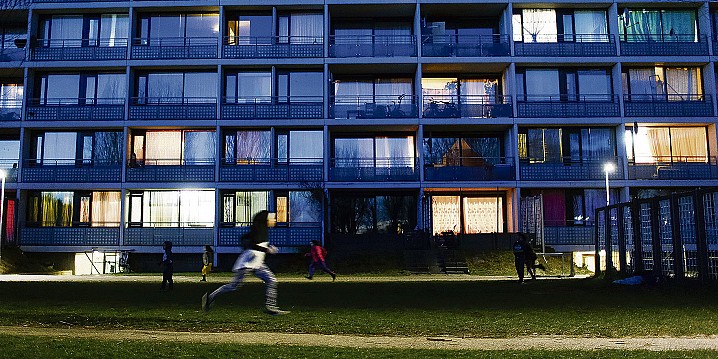
The generation gap within the families worries Bertelsen as well:
”In most cases, the up-brining has been built on two key aspects: guilt and shame. The young people are ashamed of the discrimination they have experienced, and this is something they can’t talk about with their parents.” From the radical extremist groups, the young people trying to find themselves find a community that values them.
A low, yellowish brick house next to a lorry firm houses the most notorious mosque in the country. Are the youth really being recruited into Isis here?
”We heard about this only after the police told us,” assures Imad Yasin, the vice chair of the mosque.
”These youths are able to think for themselves. We have never encouraged anyone to leave for Syria. But they have YouTube where they can see people getting killed every day. It’s impossible to stop them from begin affected and feeling what they feel.”
In Syria, the fighting between the forces of the President Bashar Al-Assad, a Shi’a Muslim, and the country’s Sunni rebels, is the source of this prolonged conflict. The resulting turmoil has made the rise of extremists groups, such as Isis, possible. According to Yasin, the people who leave for Syria are driven by a desire to defend the Sunni Muslims. This is exactly what Jihad is about: fighting for your country, for your religion, and for your own people. And not everyone leaves for Syria to fight: some leave to do things such as humanitarian work.
The mosque is trying to offer the people who are planning to leave a chance to help without leaving Denmark, such as collecting clothes which can be shipped to Syria. The mosque isn’t a recruitment centre but a place where the marginalized youth can find direction for their lives.
”The Western society hasn’t answered their question about the meaning of life. They feel like they are living in a void. They have come to us from the streets and left their criminal lives behind.”
Yasin doesn’t approve killing people in Europe because here everyone has a freedom of expression. However, it is used incorrectly in his opinion. For Muslims, Islam is more than just a religion, and sometimes other people have difficulty understanding that.
”Freedom of speech has not been created so that the strong can oppress the weak. I know many people say that Muslims are masters at playing the victim card. But our Prophet is being blasphemed. Call us whatever you want.”
Yasin is not impressed by the Western democracy.
“We call that which is happening to Muslims in Muslim countries terrorism. But could someone explain to me why the democratic Europe and USA are supporting Middle Eastern dictatorships? The politicians are fighting for oil and natural resources, and right now we’re on our way to World War III.”
According to the estimations of the Finnish Security Intelligence Service Supo, over 60 people have left Finland for Syria and Iraq. Most of them are 21 to 24 year old men. Ari Evwaraye, a senior adviser in the Ministry of the Interior, says that Finland has been working on the prevention of many different forms of religious and political radicalization since 2012. During the last year, the discussion on religious extremism in particular has become more and more heated, and it has received public attention due to the conflict in Syria.
The Aarhus model is familiar to the Finnish authorities as well. In Helsinki, the police and the social welfare services use similar methods in the Ankkuri-programme, which is trying to get the lives of the radicalized youths back on the right track. According to Evwaraye, the cooperation between the public authorities on this issue is still a bit inconsistent at the moment, but the police, the social service, the health care system and the schools can work together if the need arises. The long term objective is to create multi-professional cooperative networks in all large cities, where these networks could help to identify the signs pointing to radicalization as early as at school age.
Unlike in Denmark, in Finland the radicalization has not been concentrated on a specific city or neighbourhood. To the knowledge of the authorities, there is no organized recruitment happening in Finland.
In Finland, leaving for Syria is not punishable under law, because everyone has the right to freedom of movement. But if a person has committed acts during their travels which are punishable under the Finnish law, they can still be held accountable. But what kind of acts committed in a conflict zone are considered crimes in Finland? That depends on the specifics.
”Things like the target of the violence and the context of the violence are taken into account,” notes Evwaraye.
The Muslim communities have organized to cooperate, which has been favourably received in the Ministry of the Interior. Evwaraye emphasizes that the prevention of radicalization is an issue which concerns us all, and that no particular community has any greater responsibility to fix this issue than any other.
The freedom of religion and freedom of conscience are both part of democracy – but ideological violent isn’t.
”You’re allowed to have radical thoughts,” Evwaraye says.
Denmark doesn’t want more neighbourhoods like Gellerup. Something went wrong in the 60’s, when this city of concrete was built. Now, this mistake is meant to be put to right. The excavators, torn-down city blocks and house-sized mountains of sand are a tell-tale sign that the change is already on its way.
People want a more open Gellerup. During the next few years, a large street will divide the neighbourhood into two, jobs will be brought to the area, and owner-occupied houses are going to be built next to the rental apartments.
In the illustrations, lights from small boutiques are reflected on the pedestrian street, wet with rain. Urban planners believe that breaking up the physical space will lead to a social change as well.
The authorities in charge of the development of the Aarhus model understand that divisions in the society increase radicalization. A typical Danish person doesn’t know what it is like to be a Muslim in a Scandinavian country or to live in a ghetto.
It is hoped that, in the beginning, Gellerup will get new inhabitants from open-minded students. Aarhus has numerous universities and colleges, but a serious shortage of affordable rental apartments.
At the same time, there is a plan to build a large new mosque in the area – despite the opposition of the right-wing politicians.

Sivu: 1 2