


Somewhere over the rainbow

Founded by the local LGBTI Rights in Finland Association Seta, Mixei entered into business on Otavalankatu in 1990. Fourteen years later in 2004, the bar had a change of venue to Itsenäisyydenkatu, away from the hustle and bustle of the immediate city centre. A change of ownership took place in 2006, as Seta sold the bar to Ari Mäkelä. Last year Mr Mäkelä passed away, and the barkeeper did not seem to have a successor at first. Eager to keep the bar up and running, Pauli Huhtala decided to take the reins.
If Mixei is the backbone of the city’s LGBT community, then the legendary Leimarit must be at least a vertebra. Organized eight times a year by Pirkanmaan Seta, each Leimarit night at Yo-talo sees a gathering of 500 merrymakers. The event was held for the first time nearly three decades ago in 1988. In the original Leimautumisbileet, the name a reference to labelling and stigma, the eventgoers could imprint themselves with a range of stamps. The use of stamps was a way to comment on society’s stereotyping of minorities. Today, the event has only one stamp that says “stamp”.
Every summer the city witnesses a colourful celebration of gender and sexual minorities as Pride hits the streets. Last year two independent Prides took place in Tampere, which caused nationwide astonishment in social and traditional media. It may be due to the city’s Pride confusion that the local parades only manage to gather around 1000 participants, a modest number in comparison to the capital’s event. Helsinki Pride brings together up to 25000 participants, equalling the size of a small city.

Early birds Adele Venäläinen, Anna Javanainen, Heidi Jokinen, Jenni Jokelin (facing out), Susanna Naskali and Jenni Saarikoski at the singles night. It’s like any other Saturday night except for the bracelets signalling the person’s relationship status.
Back in the 1950s and 1960s, the attitudes in society were dramatically different. Research Fellow in Gender Studies at the University of Tampere Tuula Juvonen analysed the theme in her doctoral thesis Varjoelämää ja julkisia salaisuuksia (Shadow Lives and Public Secrets). According to Juvonen, homosexuality was deeply hidden in Tampere six decades ago. Gay men rendezvoused mainly in the parks of the city centre. The most inclusive bar was Tillikka, known as Pusta at the time.
Women without male company had limited access to bars. Lesbians remained invisible and shut away behind the doors of private homes. The lack of choice led many to opt for heterosexual marriages. The thesis interviews reveal that lesbians were not welcome to join gay men’s get-togethers before the 1970s, the decade when Tillikka opened its doors to women.
Until 1971, homosexual activity was a criminal offense with a prison sentence of up to two years. After decriminalisation of homosexual activity, the state banned enticement to homosexuality. The ban was repealed as late as 1999, making positive public discussion on homosexuality illegal before the turn of the new millennium. Homosexuality was also classified as an illness until the year 1981.
”Gay people now look for marriage candidates, whereas heterosexuals look for one-night stands.”
Tampere has had several gay bars and clubs in the past. In 2000s, as many as three gay bars coloured the city map at the same time: Mixei, Pink and Blue Oyster. A decade earlier in the mid-1990s, the bar scene also included Hospital and women-only Nice place. Mixei is the only bar still going strong.
Juvonen says the most significant change in the LGBT culture is in the points of rendezvous. From secret meetings in the parks, men have taken to frequenting bars, cafés and other public indoor spaces. Moreover, women have been liberated from constraints on movement and sexuality, and lesbians are more visible and accepted in the public.
Juvonen thinks the legal amendments have had a great impact on the LGBT dating and relationship culture.
“Homosexuals now have the right to register their partnership and have children. This has led to similar dating habits than what straight people used to have. Gay people now look for marriage candidates, whereas heterosexuals look for one-night stands.”
Juvonen says LGBT people are under more pressure to find a partner and start a life together. At the same time, the strict divide to gays, lesbians and straights is collapsing.
“Today, you are not immediately defined as gay if you have had a homosexual experience.”
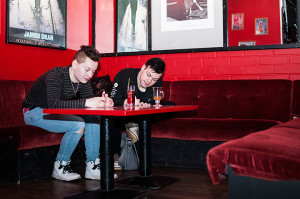
Juhani Ruupunen and Teemu Mäkelä are taking part in the regular Wednesday-night picture quiz. Mäkelä likes the atmosphere and he visits Mixei at least once a week. He thinks people drink too much in straight bars.
The Executive Director of Pirkanmaan Seta Mikko Väisänen says that the 2015 reforms of the non-discrimination and equality acts as well as the passing of the gender-neutral marriage bill are a triumph for a more equal society. However, Väisänen is concerned. As the climate in society has tensed up, Pirkanmaan Seta has been receiving more calls. Hate speech and calls about bullying are now more common.
“In the past year, people’s sense of security has wobbled. It has been caused by the tense atmosphere, as the society has been receiving more asylum seekers. Besides that, the recession stirs up emotions, which leads to guilt-tripping different minorities. For one reason or another, hate speech and acts have gained more visibility. We have no precedents of what you can say without having to suffer consequences.”
Väisänen thinks Tampere and other major cities are statistically similar, as hate speech is a countrywide problem. Nonetheless, Tampere is a pioneer in many gender and sexual minority issues. This year the City of Tampere and Pirkanmaan Seta organize more than 200 workshops for all local eighth graders. In these workshops, pupils examine issues of gender identity, self-determination and sexual orientation.