


Experiments on a human body

Animal experiments have been in the service of medicine throughout history, but people’s attitudes towards them have differed from era to era. Today, the European Commission members are required to promote the protection and welfare of animals. The EU regulation on cosmetic products bans animal experiments in cosmetics testing.
Although EU legislation requires the use of non-animal experiments whenever possible, it is not the reality. For example in chemical testing, the international community follows the OECD guidelines and alternative human cell-based tests make it to the guidelines slowly. Ficam’s first validated test would qualify as an OECD test, but the road is rocky. The test was completed in 2015 after almost 5 years in the process. Mannerström thinks that the test will qualify into the OECD guidelines within five years at the earliest. Other laboratories must test it further, and if any shortcomings are identified, the test has to be improved.
In 2014, more than 145,000 test animals were used for scientific and educational purposes in Finland. This number includes over 60,000 mice, nearly 18,000 rats and more than 50,000 fish.
Each animal experiment needs a permission from the National Animal Experiment Board. Animal testing is supervised by the Regional State Administrative Agencies of Southern and Eastern Finland.
Out of all publications that implement either animal testing or alternative methods, 90 percent use test animals
The University of Tampere has an animal experiment unit which serves the research purposes of the School of Medicine, Biomeditech and Pirkanmaa Hospital District. The Regional State Administrative Agency of Southern Finland compiles national statistics about the use of animals in experiments, but these figures do not cover local data. The state agency does not have more agent-specific statistics nor does the University publish them. For this article, Aviisi obtained data about animal testing at the University of Tampere, but was not granted an interview. According to the information provided by the University, the ratio of test animals and alternative methods has in the past years been 90 to 10 at the most. Out of all publications that implement either animal testing or alternative methods, 90 percent use test animals. Publications involving alternative methods range from 10 to 20 percent a year.
The University says that on a national scale, their animal experiment unit is fairly small, but “very significant to many successful research teams who work for the University and the Tampere University Hospital”. The unit is considered a necessary requirement for modern medical and biomedical research.
In animal testing, one essential principle is the “3Rs”: replace, reduce and refine tests. The University of Tampere also emphasizes the 3R principle.
Indeed, the number of tests on animals has decreased in Finland in recent years. However, animal rights organization Animalia thinks that this drop in the number of tests has not been a result of planning, but rather a consequence of the economic recession.
”In our opinion, the biggest problem is that there is no target programme for reducing the number of animal tests. The EU Directive on the protection of animals for scientific purposes requires member states to both reduce the use of test animals and to promote alternative research methods for animal testing”, says Animalia’s campaign manager Marianna Koljonen.
A rectangular, human-size machine stands at the back of the room. It is a live cell imaging incubator. An image of a vascular system is slowly appearing on the computer screen. Here and there you can see round shapes: fat cells.
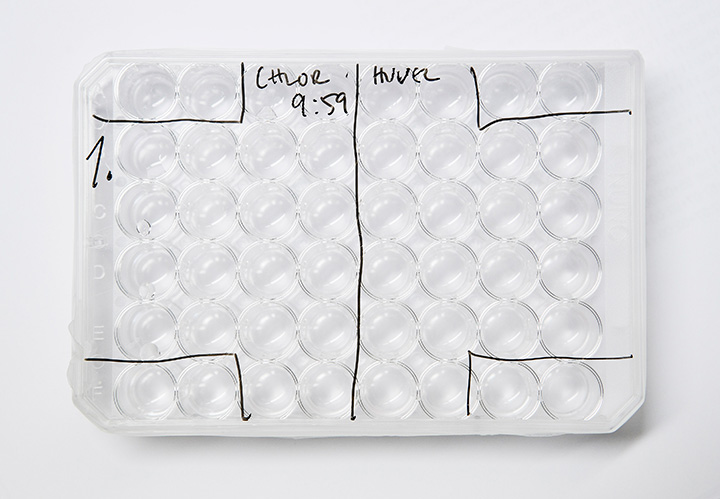
The images show you, for example, how immune cells destroy foreign organisms and materials in the wells. Indeed, the researchers at Ficam do not work alone. A range of machines and devices are there to assist them in their job, and those machines are costly.
“This one was 250,000, that one 150,000 and the third one was only 50,000”, researcher Tarja Toimela points around the room.
Ficam has sought funding for their machines independently. Toimela started at Ficam in 2007, and like most other employees there, her job is temporary. Her current contract ends in July.
“When you start work at the University, you are aware that no one in the research teams has a permanent contract.”
Ficam is funded by the Ministry of Education and Culture, the Ministry of Agriculture and Forestry and the Finnish Funding Agency for Innovation Tekes. Donations and testing services are another source of income. The University supplies Ficam with premises and support staff. Ficam’s budget is currently around 700,000 euros. State funding is temporary, covering only the rest of this year.
”The fact that we have to scrape up the budget every year is a signal that alternative methods lack adequate support. Ficam should be seen as a national source of pride and an innovative business opportunity worth investing in”, Animalia’s Koljonen says.
Animalia has been a tireless advocate of Ficam. First, they campaigned for the establishment of the centre, then they continued on to lobby for extra funding for the centre.
The funding from the Ministry of Education and Culture is on the table in the negotiations between the Ministry and the University in May. Ficam has a special national duty to develop and inform the public about alternative methods for animal testing. Besides these duties, Ficam is an EU Reference Laboratory for test and method validation. However, Mannerström reveals that Ficam has had to turn down validation cases for lack of money.
Next year, Ficam’s funding is likely to face cuts.
“For the term 2017–2020, we will have to make some cuts to the funding of national missions as well”, says Counsellor of Education Jorma Karhu from the Ministry of Education and Culture.
However, he is positive that Ficam will continue to receive funding. The Ministry of Agriculture and Forestry says that Ficam’s future funding has not been ruled out. As the issue is still work in progress, many questions remain unanswered for the time being.
“Last year, I had one or two month posts here. In that situation, it is difficult to find motivation to plan and do your work”, Outi Huttala describes her daily life as a PhD student at Ficam.
She adds that temporary contracts are not exceptional.
“When you start work at the University, you are aware that no one in the research teams has a permanent contract.”
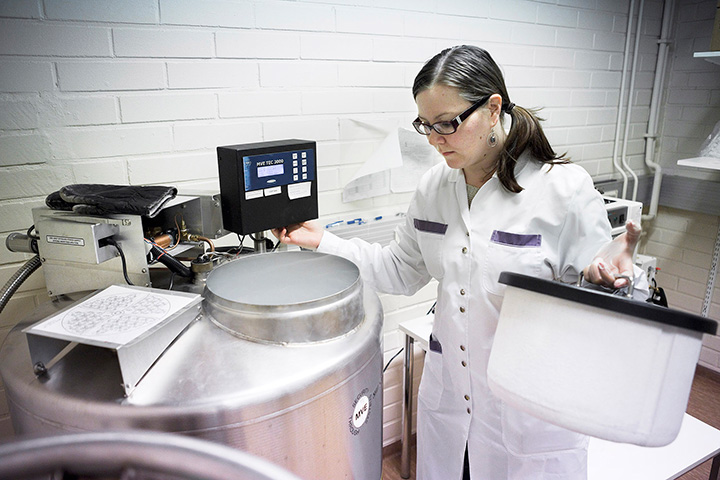
Outi Huttala joined Ficam for the opportunity to develop practical applications. She is hoping to finish her PhD in two years.